


Rancher has long been one of the most popular Kubernetes management platforms, helping organizations provision, manage, and secure Kubernetes clusters across on-premises, cloud, and edge environments. Its open-source roots, multi-cluster management capabilities, and vendor-neutral approach have made it a popular choice for platform teams.
In recent years, however, more organizations have started evaluating Rancher alternatives. For some, it's the shift in commercial licensing following SUSE (Software und System-Entwicklung)'s acquisition of Rancher. Others are looking for a managed control plane, simpler operations, stronger enterprise features, or a platform that better fits their existing infrastructure and operational model.
This guide compares the 7 best Rancher alternatives in 2026, highlighting where each platform excels, where it falls short, and how to choose the right solution for your Kubernetes environment.
The alternatives covered in this guide are:
- Platform9
- OpenShift
- Rafay
- Spectro Cloud
- VMware Tanzu
- Mirantis Kubernetes Engine
- Portainer
What Is Rancher?
Rancher is an open-source Kubernetes management platform owned by SUSE that helps organizations deploy, manage, and secure Kubernetes clusters across cloud, on-premises, and edge environments from a single control plane.
It is popular for its multi-cluster management, vendor-neutral approach, and support for multiple Kubernetes distributions. Rancher is available as both a free Community Edition and the commercial Rancher Prime offering.
Why teams are looking for Rancher alternatives
Changing commercial licensing: Since SUSE introduced Rancher Prime, some organizations have reported significantly higher licensing costs, prompting them to reevaluate whether Rancher remains the right long-term platform.
Operational complexity: Running Rancher means managing the management platform itself. Teams must deploy, upgrade, monitor, and maintain the Rancher control plane alongside the Kubernetes clusters it manages.
Ongoing maintenance: Regular upgrades and lifecycle management require dedicated platform engineering resources. For smaller teams, the operational overhead can outweigh the benefits of self-managing Kubernetes.
Different infrastructure needs: Some organizations are looking for managed Kubernetes platforms, while others need stronger enterprise governance, better developer experience, or broader hybrid and multi-cloud support.
With these considerations in mind, here's what to evaluate when comparing Rancher alternatives.
What to look for in a Rancher alternative
When evaluating Rancher alternatives, consider the capabilities that matter most to your Kubernetes environment:
- Multi-cluster management: Support for managing Kubernetes clusters across cloud, on-premises, and edge environments.
- Operational simplicity: A platform that minimizes the effort required to deploy, upgrade, and maintain Kubernetes.
- Security and governance: Features such as RBAC, policy enforcement, identity integration, and compliance controls.
- Deployment flexibility: Support for self-managed, managed, hybrid, or multi-cloud Kubernetes deployments.
- Developer experience: GitOps integration, APIs, Terraform support, and automation capabilities for modern DevOps workflows.
- Scalability: The ability to manage growing Kubernetes environments without adding significant operational overhead.
- Pricing and licensing: Transparent pricing, licensing flexibility, and a model that aligns with your long-term infrastructure strategy.
The best Rancher alternatives
1. Platform9
Platform9 is a Kubernetes management platform that provides a SaaS-hosted control plane for managing clusters across public cloud, on-premises, and edge environments. Unlike Rancher, which requires organizations to deploy and maintain the management server, Platform9 manages the control plane for you, reducing operational overhead while preserving multi-cluster management capabilities.
Best for: Organizations that want Rancher-like multi-cluster management without maintaining the management platform.
Key features
- SaaS-managed control plane: Platform9 hosts, patches, and upgrades the management plane, eliminating the need to operate Rancher Server.
- Multi-cluster management: Manage Kubernetes clusters across public cloud, private cloud, on-premises, and edge environments from a single interface.
- Lifecycle automation: Built-in cluster provisioning, upgrades, and Day-2 operations reduce ongoing administrative effort.
- Broad Kubernetes compatibility: Supports upstream Kubernetes and existing Kubernetes distributions without requiring migration to a proprietary platform.
Strengths
- Lower operational overhead: Removes one of Rancher's biggest pain points by managing the control plane as a service.
- Simplified lifecycle management: Platform9 automates upgrades, patching, and cluster operations, reducing platform engineering effort.
- Hybrid and multi-cloud ready: Designed to manage Kubernetes consistently across cloud, on-premises, and edge infrastructure.
Weaknesses
- SaaS deployment model: Organizations with strict air-gapped or fully self-hosted requirements may prefer Rancher or another self-managed platform.
- Commercial licensing: Advanced capabilities require a paid subscription beyond the free community offering.
Pricing
- Community Edition: Free.
- Growth: Starts at $160 per node/month (or $4 per vCPU/month) with annual billing.
- Enterprise: Custom pricing for large-scale deployments and enterprise support.
Why choose Platform9?
Platform9 is one of the closest alternatives to Rancher. It delivers the same centralized, multi-cluster management experience while eliminating the need to deploy, patch, and maintain the management platform yourself. For organizations looking to reduce Kubernetes operational overhead without giving up hybrid or multi-cloud support, it's one of the strongest Rancher alternatives available today.
2. OpenShift
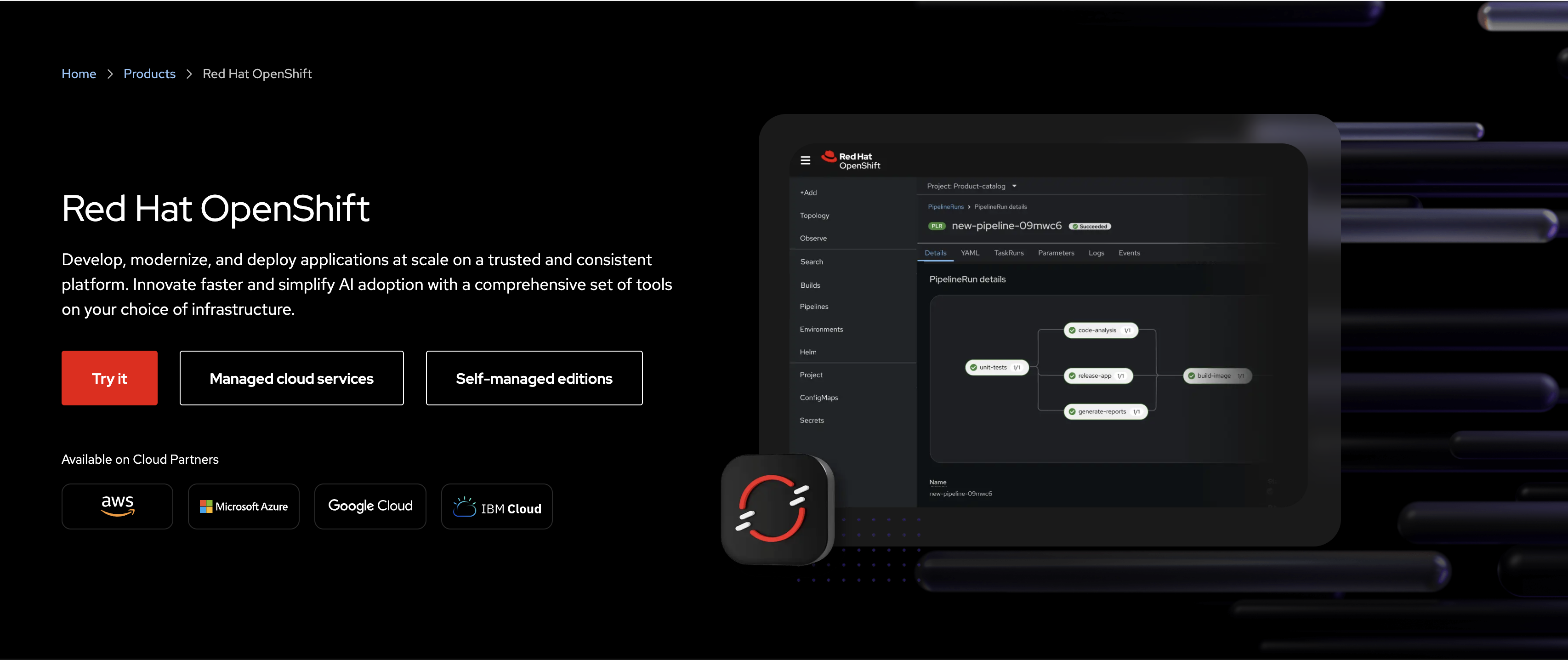
OpenShift is Red Hat's enterprise Kubernetes platform that combines Kubernetes management with integrated development, security, and automation tools. Compared to Rancher, OpenShift provides a more complete platform with many enterprise capabilities built in rather than relying on third-party integrations.
Best for: Large enterprises and regulated industries that require integrated security, compliance, and developer tooling.
Key features
- Integrated developer platform: Built-in Continuous Integration and Continuous Delivery (CI/CD) with Tekton, GitOps using Argo CD, and developer tools.
- Enterprise security: Security-Enhanced Linux (SELinux) enforcement, compliance features, and Role-Based Access Control (RBAC).
- Flexible deployment: Available as a self-managed platform or fully managed through Red Hat OpenShift Service on AWS (ROSA) and Azure Red Hat OpenShift (ARO).
Strengths
- Enterprise-ready platform: Security, compliance, and developer tools are integrated out of the box.
- Managed deployment options: ROSA and ARO reduce the operational overhead of managing the Kubernetes control plane.
Weaknesses
- Higher complexity: More resource-intensive and harder to learn than Rancher and lighter alternatives.
- Higher cost: Enterprise licensing may be difficult to justify for smaller teams.
Pricing
- OKD (Origin Community Distribution): Free, community-supported upstream distribution.
- OpenShift Platform Plus: Subscription-based pricing, typically licensed per virtual CPU (vCPU) or core.
- Managed services: ROSA and ARO are billed based on infrastructure usage plus OpenShift licensing.
Why choose OpenShift?
Choose OpenShift if you need an enterprise Kubernetes platform with integrated security, compliance, and developer tooling. It is a strong alternative for organizations that have outgrown Rancher's management capabilities or operate in highly regulated environments.
3. Rafay
Rafay is an enterprise Kubernetes management platform that simplifies multi-cluster operations across public cloud, private cloud, and edge environments. Compared to Rancher, Rafay places a stronger emphasis on governance, policy enforcement, and self-service workflows for large platform engineering teams.
Best for: Large enterprises that need centralized governance across multiple Kubernetes clusters and teams.
Key features
- Policy-based governance: Built-in Open Policy Agent (OPA) integration for policy enforcement and compliance.
- Multi-cluster management: Manage Kubernetes clusters across cloud, on-premises, and edge environments from a single platform.
- Blueprint-based automation: Standardize cluster provisioning and lifecycle management using reusable templates.
Strengths
- Enterprise governance: Strong policy enforcement and standardized operations for large organizations.
- Platform engineering focus: Self-service workflows help platform teams support multiple development teams efficiently.
Weaknesses
- Enterprise-oriented: May be more complex than necessary for smaller organizations.
- Commercial platform: Advanced capabilities require an enterprise subscription.
Pricing
- Platform: Enterprise subscription with custom pricing based on deployment size and support requirements.
Why choose Rafay?
Choose Rafay if governance and standardization are your highest priorities. Its policy-driven approach makes it a strong Rancher alternative for enterprises managing large Kubernetes environments across multiple teams.
4. Spectro Cloud
Spectro Cloud is a Kubernetes management platform that automates cluster lifecycle management across cloud, bare metal, edge, and hybrid environments. Compared to Rancher, Spectro Cloud places a stronger emphasis on declarative infrastructure, allowing teams to manage entire Kubernetes stacks through version-controlled cluster profiles.
Best for: Organizations managing large Kubernetes deployments across edge, bare-metal, and hybrid environments.
Key features
- Cluster Profiles: Version-control Kubernetes clusters, operating systems, and add-ons as a single configuration.
- Multi-cluster management: Centrally manage Kubernetes deployments across cloud, bare metal, and edge environments.
- Palette platform: Unified dashboard for cluster provisioning, monitoring, and lifecycle management.
Strengths
- Declarative lifecycle management: Simplifies cluster provisioning, upgrades, and configuration management at scale.
- Edge and hybrid support: Designed for large distributed Kubernetes environments where centralized management is essential.
Weaknesses
- Commercial platform: Enterprise-focused licensing may not suit smaller organizations.
- Smaller ecosystem: Fewer community resources and third-party integrations than Rancher or OpenShift.
Pricing
- Platform: Enterprise subscription with custom pricing based on deployment size and support requirements.
Why choose Spectro Cloud?
Choose Spectro Cloud if you're managing Kubernetes across edge, bare-metal, or hybrid environments. Its declarative approach to cluster lifecycle management makes it a strong alternative for organizations that have outgrown Rancher's operational model and need to manage large Kubernetes fleets consistently.
5. VMware Tanzu
VMware Tanzu is an enterprise Kubernetes platform that integrates Kubernetes directly with VMware vSphere, enabling organizations to manage virtual machines and Kubernetes workloads from the same infrastructure. Compared to Rancher, Tanzu is better suited for organizations already invested in the VMware ecosystem.
Best for: Enterprises running VMware infrastructure that want to modernize applications with Kubernetes.
Key features
- Native VMware integration: Built to run Kubernetes alongside virtual machines on VMware vSphere.
- Multi-cluster management: VMware Tanzu Mission Control (TMC) provides centralized cluster lifecycle and policy management.
- Enterprise platform: Integrated security, networking, and automation for VMware-based environments.
Strengths
- Seamless VMware experience: Simplifies Kubernetes adoption for organizations already using VMware infrastructure.
- Unified infrastructure management: Manage virtual machines and Kubernetes clusters from a consistent platform.
Weaknesses
- Higher licensing costs: VMware's licensing changes under Broadcom have increased costs for many enterprise customers.
- VMware-centric: Less attractive for organizations running primarily in public cloud or heterogeneous environments.
Pricing
- Platform: Enterprise subscription pricing, typically bundled with VMware Cloud Foundation or Tanzu editions. Pricing varies by deployment model and licensing agreement.
Why choose VMware Tanzu?
Choose VMware Tanzu if your organization already relies on VMware vSphere. Its deep integration with the VMware ecosystem makes it a natural alternative to Rancher for enterprises looking to adopt Kubernetes without introducing a separate management platform.
6. Mirantis Kubernetes Engine
Mirantis Kubernetes Engine (MKE) is an enterprise container management platform that supports both Kubernetes and Docker Swarm from a single control plane. Compared to Rancher, MKE is particularly well suited for organizations migrating legacy Docker Swarm environments to Kubernetes without managing two separate orchestration platforms.
Best for: Organizations migrating from Docker Swarm to Kubernetes or managing mixed container environments.
Key features
- Unified orchestration: Manage Kubernetes and Docker Swarm clusters from a single control plane.
- Enterprise security: Built-in Role-Based Access Control (RBAC), image signing, and supply chain security features.
- Cluster lifecycle management: Simplifies provisioning, upgrades, and ongoing Kubernetes operations.
Strengths
- Docker Swarm migration: One of the few platforms that natively supports both Docker Swarm and Kubernetes.
- Enterprise-ready: Strong security, governance, and lifecycle management for production workloads.
Weaknesses
- Specialized use case: Provides the greatest value for organizations still running Docker Swarm.
- Commercial licensing: Less attractive for smaller teams looking for an open-source solution.
Pricing
- Platform: Enterprise subscription with custom pricing based on deployment size and support requirements.
Why choose Mirantis Kubernetes Engine?
Choose Mirantis Kubernetes Engine if you're migrating from Docker Swarm to Kubernetes. Its dual-orchestrator support makes it one of the strongest alternatives to Rancher for organizations modernizing legacy container environments without disrupting existing workloads.
7. Portainer
Portainer is a lightweight container management platform that manages Kubernetes, Docker, Docker Swarm, Podman, and Microsoft Azure Container Instances (ACI) from a single interface. Compared to Rancher, Portainer is simpler to deploy and manage, making it a popular choice for smaller teams and mixed container environments.
Best for: Small to medium-sized teams managing Kubernetes alongside Docker-based workloads.
Key features
- Lightweight deployment: Runs as a single container with a simple installation process.
- Multi-platform management: Manage Kubernetes, Docker, Docker Swarm, Podman, and ACI from one interface.
- Access management: Built-in Role-Based Access Control (RBAC) and team management features.
Strengths
- Simple to operate: Easier to deploy and maintain than Rancher's management platform.
- Broader container support: Manages both Kubernetes and non-Kubernetes container environments from a single console.
Weaknesses
- Limited enterprise governance: Offers fewer multi-cluster governance and policy management capabilities than Rancher or OpenShift.
- Smaller feature set: Focuses on container management rather than providing a full enterprise Kubernetes platform.
Pricing
- Community Edition: Free and open source.
- Business Edition: Subscription-based pricing with additional features such as OpenID Connect (OIDC), Single Sign-On (SSO), and advanced RBAC.
Why choose Portainer?
Choose Portainer if you want a lightweight alternative to Rancher with a simpler deployment model and support for both Kubernetes and Docker environments. It is particularly well suited to smaller teams that don't need the complexity of a full Kubernetes management platform.
When a Kubernetes Management Platform Isn't the Right Fit
Not every organization looking for a Rancher alternative needs another Kubernetes management platform.
Rancher and the platforms in this comparison are designed for teams that operate Kubernetes at scale. If your goal is simply to deploy applications on Kubernetes rather than manage clusters, upgrades, and control planes, a fully managed Kubernetes platform may be a better fit.
Rackspace Spot is one example. It provides a fully managed Kubernetes service with a free control plane, built-in autoscaling, and support for both on-demand and spot instances. Rather than managing the Kubernetes platform yourself, your team can focus on deploying and scaling applications.
For organizations that don't require advanced multi-cluster governance, a managed Kubernetes platform can reduce operational overhead while lowering infrastructure costs.
Frequently Asked Questions
What are the best Rancher alternatives in 2026?
Platform9 is one of the closest alternatives to Rancher, offering multi-cluster management without requiring a self-managed control plane. Other leading alternatives include OpenShift, Rafay, Spectro Cloud, VMware Tanzu, Mirantis Kubernetes Engine, and Portainer.
Why are organizations looking for Rancher alternatives?
The most common reasons include changes to Rancher Prime licensing under SUSE, the operational overhead of maintaining the Rancher management platform, and the need for simpler or more specialized Kubernetes management solutions.
Which Rancher alternative is best for enterprise environments?
OpenShift is a strong choice for enterprises that require integrated security, compliance, and developer tooling. Rafay and VMware Tanzu are also well suited to large organizations managing Kubernetes across multiple teams and environments.
Which Rancher alternative is best for hybrid and multi-cloud deployments?
Platform9, Spectro Cloud, and Rafay all support Kubernetes across public cloud, private cloud, on-premises, and edge environments, making them strong choices for hybrid and multi-cloud deployments.
Which Rancher alternative is best for Docker Swarm migrations?
Mirantis Kubernetes Engine is one of the best options for organizations migrating from Docker Swarm to Kubernetes. It supports both orchestrators from a single control plane, simplifying the transition.
Is there a free alternative to Rancher?
Yes. Platform9 offers a free Community Edition, while Portainer Community Edition is also free and open source. OpenShift's upstream project, Origin Community Distribution (OKD), provides another free option for teams comfortable managing their own platform.
Which Rancher alternative is best for small teams?
Portainer is a good choice for small and medium-sized teams that want a lightweight platform for managing Kubernetes and Docker environments without the complexity of a full enterprise Kubernetes management solution.
Which Rancher alternative is best for reducing operational overhead?
Platform9 reduces operational overhead by managing the Kubernetes control plane as a service, while organizations that don't want to manage Kubernetes at all may prefer a fully managed Kubernetes platform such as Rackspace Spot.
Do I need a Kubernetes management platform?
Not always. If your primary goal is deploying applications rather than operating Kubernetes infrastructure, a fully managed Kubernetes platform like Rackspace Spot may be a better fit. Organizations that need centralized governance across multiple Kubernetes clusters, however, will benefit from a dedicated management platform such as Platform9, OpenShift, or Rafay.
Can I migrate from Rancher to another platform?
Yes. Most organizations migrate gradually by moving workloads or clusters to a new management platform over time. The migration approach depends on your Kubernetes distribution, infrastructure, and operational requirements.
What is the best Kubernetes platform for teams that don't want to manage clusters?
If you don't want to manage Kubernetes control planes, upgrades, or infrastructure yourself, Rackspace Spot is a strong option. It provides a fully managed Kubernetes platform with a free control plane, built-in autoscaling, and support for both on-demand and spot instances, reducing the operational overhead associated with self-managed Kubernetes.