


Kubernetes powers modern cloud-native infrastructure, but managing it yourself is a different challenge entirely. Cluster upgrades, security patches, and on-call burdens pull engineering teams away from higher-value work. According to the 2025 CNCF Annual Cloud Native Survey, complexity and lack of training remain the top operational blockers, even as 82% of organizations now run Kubernetes in production.
The debate has shifted. Teams are no longer deciding whether to use Kubernetes, but how much of it to manage internally. With 79% of Kubernetes users already running managed services rather than self-managed clusters, the industry’s direction is clear.
The provider market is crowded, and choosing the wrong platform carries real consequences. Vendor lock-in, unexpected cost increases, and services teams outgrow within months can create long-term operational problems. This guide compares the 10 best managed Kubernetes providers for 2026 based on features, pricing, scalability, and real-world use case fit.
Here's a quick look at the 10 best managed Kubernetes providers:
- Rackspace Spot
- Google Kubernetes Engine
- Amazon Elastic Kubernetes Service
- Azure Kubernetes Service
- Red Hat OpenShift Kubernetes
- Rancher
- Mirantis Kubernetes Engine
- Nutanix Kubernetes Platform
- IBM Cloud Kubernetes
- Linode Kubernetes Engine
TL;DR
The managed Kubernetes market in 2026 breaks into three clear categories: hyperscalers built for enterprise scale, open-source platforms built for flexibility, and specialist providers focused on cost efficiency or developer simplicity. Each serves a different kind of team, and the wrong fit quickly compounds operational and infrastructure costs.
Cost is where most teams feel the pressure most directly. A CNCF microsurvey found 70% of teams over-provision Kubernetes resources, quietly inflating infrastructure spend. Rackspace Spot takes a different approach, using an open-market auction model. The control plane comes free, while competitors charge up to $72 per month, and teams report savings exceeding 80% compared to AWS EKS and GKE.
Beyond pricing, Rackspace Spot deploys, scales, monitors, and automatically upgrades Kubernetes, significantly reducing the operational overhead teams would otherwise manage themselves. Teams can manage clusters through a web dashboard, spotctl CLI, or Terraform provider, supporting GitOps workflows natively.
With 98% GitOps adoption across the platform and more than 10,000+ active production workloads, Rackspace Spot positions itself as one of the more operationally complete managed Kubernetes platforms currently available.
Why teams choose managed Kubernetes
Self-managing Kubernetes works at a small scale but becomes a significant operational commitment as infrastructure grows. The demands compound, and for most engineering teams, maintaining clusters competes directly with building the actual product. Managed Kubernetes changes that equation. Here are the core reasons teams make the move.
1. Reduced Operational Overhead
Managing Kubernetes in-house demands dedicated engineering resources across every layer of the stack. Significant operational requirements, such as upgrading Kubernetes versions, applying security patches, and ensuring continuous compliance add to this overhead, often requiring specialized personnel to focus exclusively on Kubernetes management. Managed Kubernetes absorbs these recurring tasks, giving engineering teams more time to build products rather than maintain infrastructure.
2. Immediate Access to Kubernetes Expertise
Building an internal platform engineering team with deep Kubernetes knowledge is expensive and time-consuming. Kubernetes engineers remain among the highest-paid roles in DevOps, and the hiring cycles can take months. With more than 110,000 Kubernetes-related job listings on LinkedIn as of 2025, the talent market remains highly competitive. Managed providers deliver that operational expertise as part of the service without requiring teams to build a large internal platform group.
3. Built-In Security and Compliance
The Red Hat State of Kubernetes Security Report 2024, based on a survey of 600 professionals, found that 67% of organizations have delayed or slowed application development due to security concerns. Managed Kubernetes providers handle control-plane hardening, RBAC configuration, security patching, and compliance tooling for standards such as SOC 2 and GDPR, reducing much of that operational risk early.
4. Automated Scaling
Manual cluster scaling forces engineers to size instances ahead of demand and intervene during traffic spikes. That approach often leads to over-provisioned clusters during quiet periods and insufficient capacity during sudden demand increases. Managed Kubernetes platforms automate this through Horizontal Pod Autoscaling and cluster autoscalers, adjusting resources based on workload conditions without human intervention.
5. Faster Time to Production
Production environment setups in self-managed Kubernetes can take anywhere from days to months. Every component, from networking to monitoring to security configuration, requires manual setup and validation before workloads can move safely into production. Managed providers shorten that timeline considerably, delivering production-ready infrastructure faster while reducing the infrastructure burden on development teams.
The 10 best managed Kubernetes service providers
The providers below represent the leading managed Kubernetes platforms available in 2026. Each delivers production-grade cluster management, automated scaling, and built-in security capabilities for teams ranging from startups to enterprises.
1. Rackspace Spot
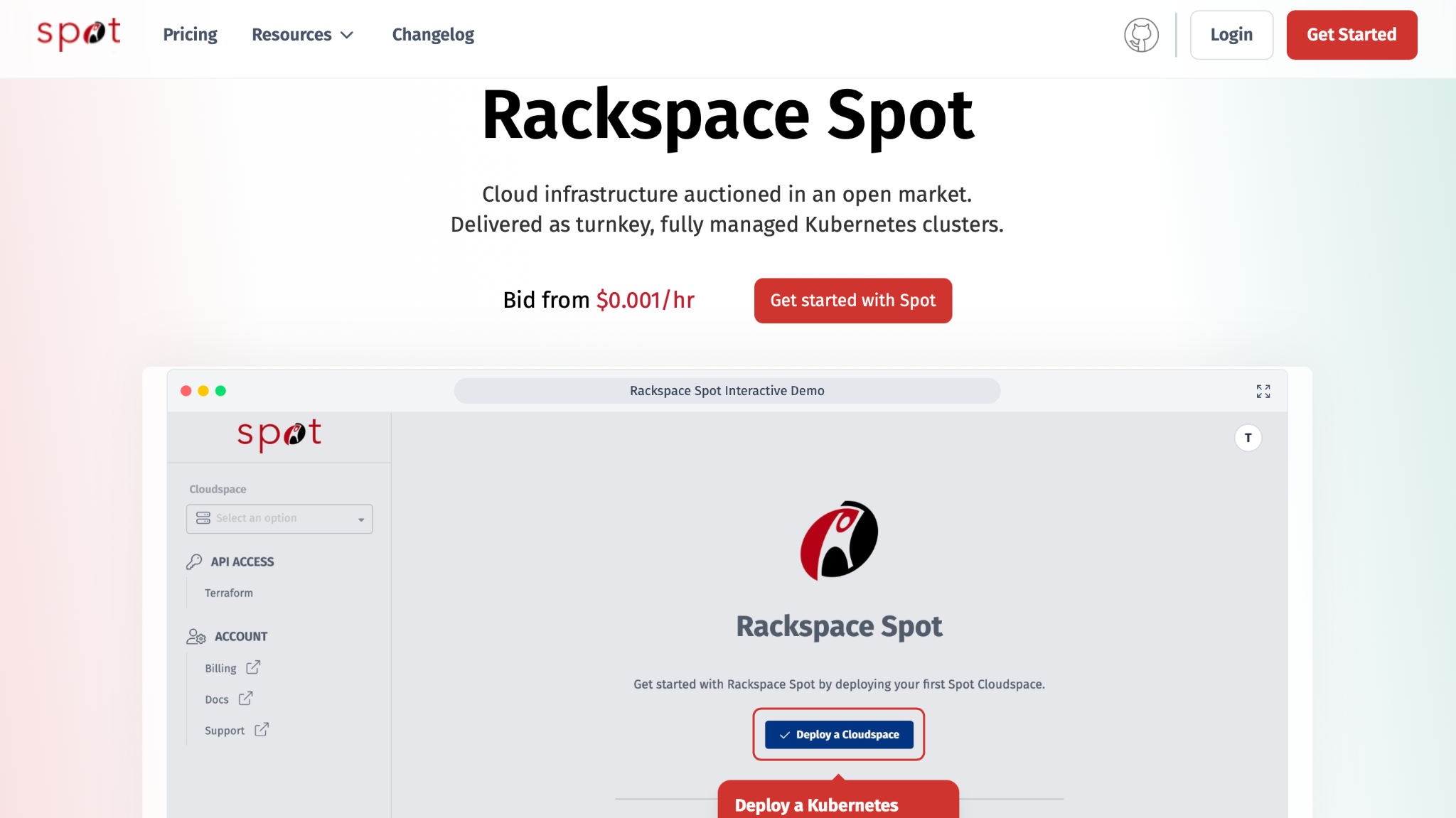
Rackspace Spot is the only managed Kubernetes provider to deliver fully managed clusters through an open-market auction, making enterprise-grade Kubernetes accessible at a fraction of what major cloud providers charge. Co-developed by Rackspace Technology and Platform9, the leading independent provider of SaaS-managed Kubernetes, Rackspace Spot gives developers, DevOps engineers, startups, and small to medium enterprises a turnkey Kubernetes platform without the pricing opacity common in hyperscaler environments.
Teams sign up instantly, set their own compute bid price, and get production-ready clusters delivered in minutes. With SSD and SATA persistent storage classes included out of the box and a network-policy-capable CNI built in, the platform supports production workloads from day one.
The pricing model is what separates Rackspace Spot from most managed Kubernetes providers. Instead of fixed per-cluster fees or reserved compute commitments, Spot runs a real-time open market where supply and demand determine pricing. Teams can see available capacity, monitor market pricing thresholds, and bid accordingly.
The platform's 98% GitOps adoption rate is more than double the industry benchmark of ~45%, and 51% of cloudspaces run stateful production workloads, a strong signal that engineering teams trust Rackspace Spot for persistent, production-critical applications.
Key Features
- Open market auction engine: Users set their own bid price; the market determines the final cost based on real-time supply and demand from Rackspace's cloud capacity inventory
- Fully managed control plane: Each cluster gets its own dedicated hosted control plane; Rackspace manages patching, version upgrades, and availability, significantly reducing day-two operations for the team
- High availability control plane: A built-in HA option delivers production-grade reliability and uptime for critical workloads
- Auto-scaling node pools: Clusters adjust dynamically to workload demand, scaling up during peak traffic and back down when demand drops
Fast cluster provisioning: New clusters provision within minutes, reducing time from sign-up to production
Strengths
- Lowest cost managed Kubernetes: Transparent, market-driven pricing with full visibility into capacity and price thresholds before bidding
- Free control plane: The Kubernetes control plane costs nothing on Rackspace Spot, giving teams immediate cost savings that compound as workloads and cluster count grow
- No long-term contracts: Teams pay for what they use, billed to the second, with no lock-in or commitment required
- GitOps-first architecture: Every cluster resource is fully configurable through Terraform, letting platform teams enforce infrastructure consistency through pull requests and automated pipelines
- Node pre-emption alerts: Teams receive advance notifications when nodes face pre-emption, giving engineers time to manage workloads before interruption
Weaknesses
- Rackspace Spot currently supports only managed PostgreSQL as its Database-as-a-Service offering, compared to the broader range of managed database services available from other cloud providers
- Smaller regional footprint: fewer data center locations than hyperscalers, which limits options for latency-sensitive or globally distributed deployments
- Server variety is limited to Rackspace's cloud capacity pool: teams needing specific instance configurations may find fewer compute options than hyperscalers provide
Pricing
Rackspace Spot has the cheapest compute hours on the internet. There is an open market auction and it bills to the second based on actual usage. Clusters start from as little as $0.72 per month. Market prices begin as low as $0.001 per hour per server, delivering savings of over 90% compared to traditional on-demand cloud pricing. There are no upfront fees, no reserved instance commitments, and no hidden charges tied to the control plane. Teams only pay for the compute they use, with full pricing transparency before each bid.
Customer Reviews
Robert Putt, Platform Engineer: "The Terraform integration and hands-free Kubernetes management delivers massive value for the price."
Chris White, DevOps Lead: "It's really fast and a great hardware choice, easy to use." spot.rackspace
Why Choose Rackspace Spot: Rackspace Spot suits engineering teams that need managed Kubernetes without the cost overhead common in hyperscaler environments. It is a strong fit for startups scaling containerized infrastructure, DevOps engineers who prefer managing infrastructure through code, and cost-conscious teams moving away from self-managed clusters. With a free control plane, second-by-second billing, and GitOps-native tooling, Spot delivers Kubernetes at pricing levels that major cloud providers struggle to match.
2. Google Kubernetes Engine (GKE)
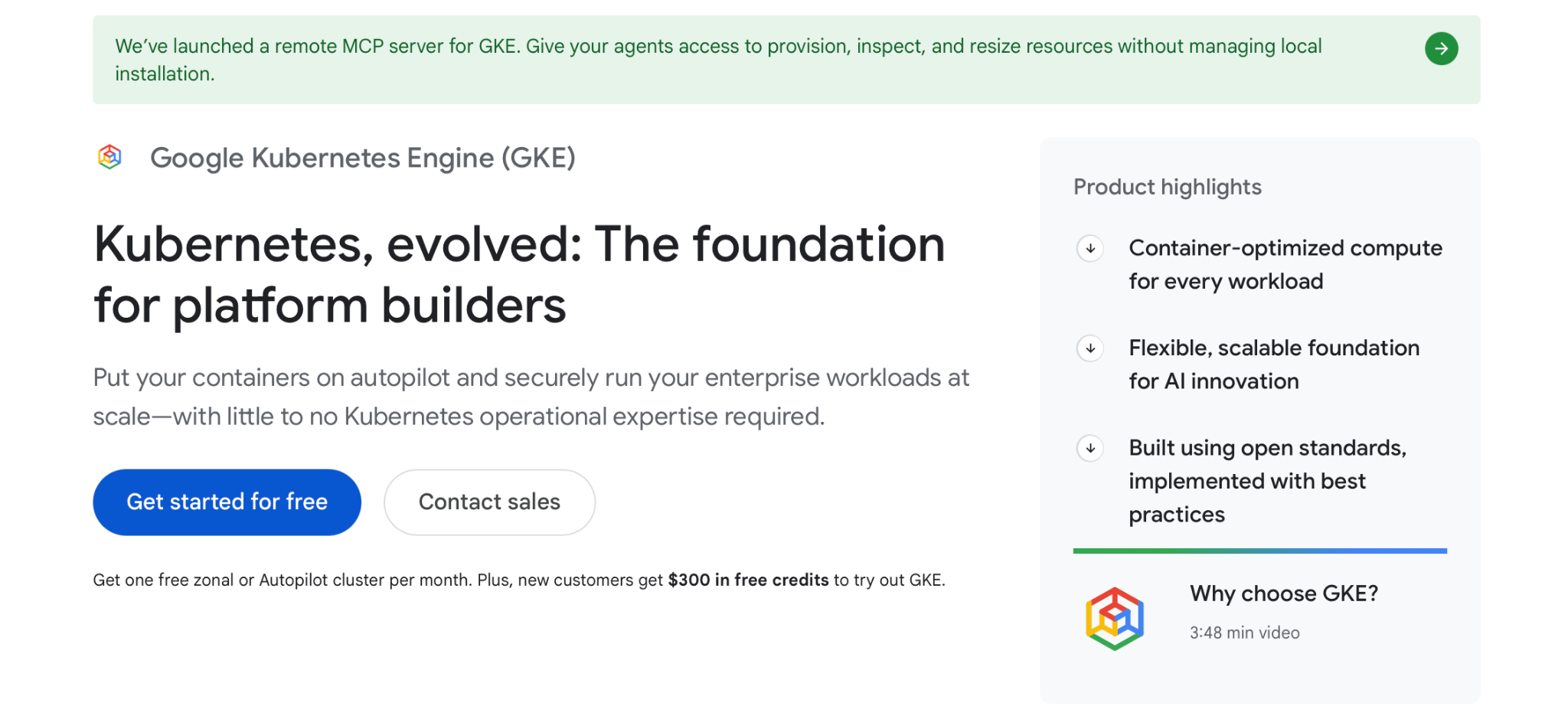
Google Kubernetes Engine runs containerized workloads on Google Cloud infrastructure, automatically handling node provisioning, scaling, version upgrades, and deletion.
Two operating modes give teams different levels of control. Standard leaves node pool management in the team's hands and bills against Compute Engine VM rates. Autopilot removes most infrastructure decisions, with Google automatically right-sizing capacity and billing per pod resource requests rather than per node.
Key Features
- Autopilot mode: pod-based billing, fully managed nodes
- HPA, VPA, and cluster autoscaling included
- Deep Google Cloud integration: Cloud Build, Artifact Registry
- Multi-cluster fleet management across regions
Strengths
- 99.95% Autopilot control plane SLA
- Zero-config built-in monitoring and logging
- Native GPU node pools for AI/ML
Weaknesses
- Surrounding services compound costs fast
- Steep advanced networking learning curve
- Deep Google Cloud vendor lock-in risk
- Per-cluster fees multiply at scale
Pricing
$0.10 per cluster per hour for management, with one free cluster monthly through a $74.40 credit. Node compute is billed separately at Compute Engine rates, and costs rise quickly across multi-cluster deployments.
G2 Rating: 4.4/5.0
Why Choose GKE: Best for large engineering teams already in the Google Cloud ecosystem that need deep native integrations and advanced autoscaling. Requires dedicated budget and strong Kubernetes expertise.
3. Amazon Elastic Kubernetes Service (EKS)
Amazon Elastic Kubernetes Service runs the Kubernetes control plane across three AWS Availability Zones, automatically detecting and replacing unhealthy control plane nodes. It is certified Kubernetes-conformant, so workloads built on upstream Kubernetes run on EKS without modification.
EKS supports three compute modes: managed EC2 node groups, serverless Fargate, and self-managed nodes
Key Features
- EKS Auto Mode: automates node provisioning, scaling, and cluster management
- Deep AWS integrations: native connectivity with IAM, VPC, CloudWatch, ECR, and EBS
- Multi-environment support: cloud, on-premises via EKS Anywhere, and hybrid setups
- Fargate support: serverless compute with fully isolated pod environments
Strengths
- Deepest AWS-native integrations across security, networking, and storage
- Control plane runs across multiple availability zones with no single point of failure
- Flexible compute: mix on-demand, spot, and Fargate in one cluster
Weaknesses
- $73/month per cluster before a single node runs
- Missing a version upgrade jumps costs to $438/month automatically
- IAM and VPC configuration require significant AWS expertise
- Two to three mandatory version upgrades required every year
Pricing
$0.10 per cluster per hour under standard support, totaling $73 monthly. Extended support increases this to $438 per month. Node compute, storage, and networking are billed separately.
G2 Rating: 4.5/5.0
Why Choose EKS: Best for large enterprises running mission-critical workloads on Amazon Web Services that need deep native integrations, flexible compute options, and the budget and expertise to manage operational complexity.
4. Azure Kubernetes Service (AKS)
Azure Kubernetes Service handles control plane provisioning, upgrades, and scaling on Azure infrastructure automatically. It integrates natively with Microsoft Entra ID, Azure DevOps, and Azure Monitor, making it a primary Kubernetes platform for enterprises already operating within the Microsoft ecosystem.
Key Features
- Free control plane: no cost on the free tier
- Microsoft Entra ID: fine-grained RBAC via existing Microsoft identity
- Azure Monitor: built-in cluster observability with Container Insights
- Arc-enabled Kubernetes: hybrid and multi-cloud cluster management via Azure Arc
Strengths
- Free control plane: direct cost advantage over EKS
- Deepest Microsoft integrations: Microsoft Entra ID, DevOps, and compliance tooling
- Built-in compliance: Microsoft Defender for Cloud, RBAC, and network policies
Weaknesses
- Pricing hard to estimate upfront
- Vendor lock-in from deep Azure integrations
- Cluster and node provisioning takes several minutes
- Shorter Kubernetes support window: 12 months standard support vs 14+ months on EKS and GKE, requiring more frequent version upgrades
Pricing
Free tier: $0 per cluster with no SLA. Standard tier: $0.10 per cluster per hour with a financially backed 99.95% SLA on Availability Zone clusters. Node compute, storage, and networking billed separately.
G2 Rating: 4.4/5.0
Why Choose AKS: Best for enterprises already running Microsoft 365, Microsoft Entra ID, and Azure DevOps who need strong compliance tooling, identity management, and a cost-efficient control plane at scale.
5. Red Hat OpenShift Kubernetes Engine
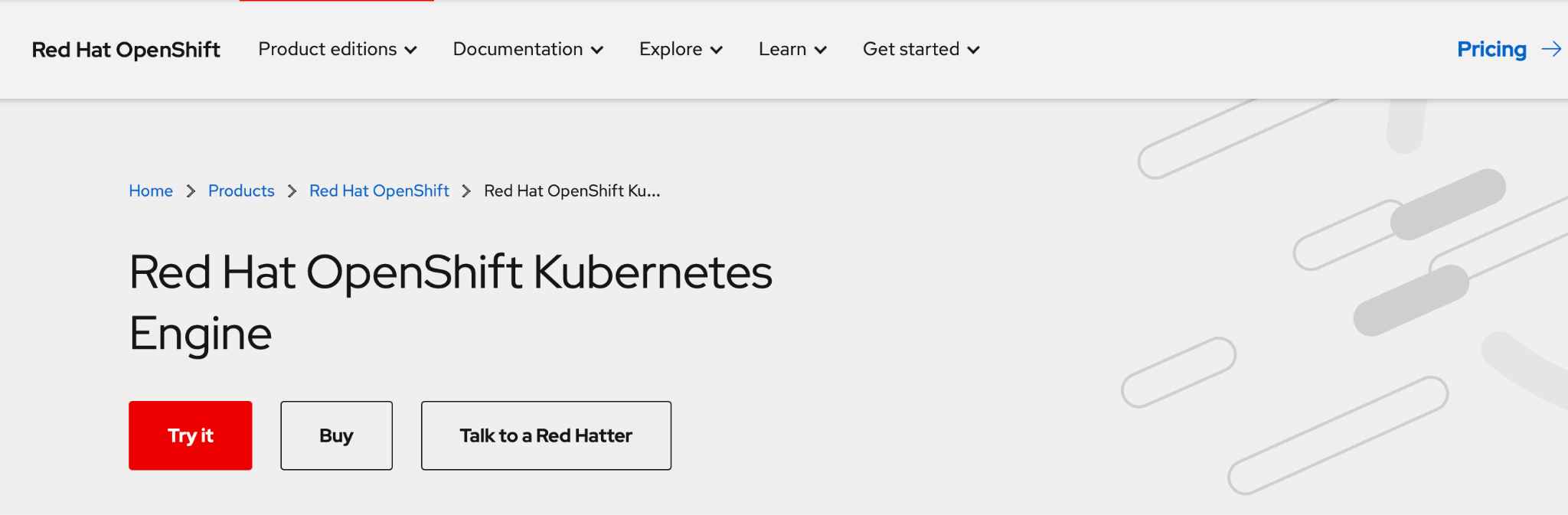
Red Hat OpenShift is an enterprise Kubernetes platform built on Red Hat Enterprise Linux CoreOS, designed for security, compliance, and hybrid cloud flexibility. It runs consistently across major public clouds and on-premises environments, serving as a standard Kubernetes platform for regulated industries.
Key Features
- Enterprise security: RBAC, Security Context Constraints, and hardened container runtime
- Automated upgrades: over-the-air cluster lifecycle management built in
- OpenShift Virtualization: VM and container workloads on one platform
- Hybrid support: consistent management across public cloud and on-premises
Strengths
- Strongest security posture: security-first defaults preferred by regulated industries
- Enterprise support: patches and upgrades included in subscription
- Hybrid flexibility: consistent platform experience across any infrastructure
Weaknesses
- Expensive: subscriptions can exceed underlying compute costs
- Steep learning curve: proprietary abstractions over vanilla Kubernetes
- Version lag: runs older Kubernetes versions, missing upstream features
- High upgrade overhead: major upgrades demand significant platform team time
Pricing
Subscription-based pricing per node or core pair with Standard and Premium support tiers. Pay-as-you-go is available on Amazon Web Services via ROSA. No public flat rate is listed; pricing requires a Red Hat quote.
G2 Rating: 4.5/5.0
Why Choose OpenShift: Best for large enterprises and regulated industries that prioritize security compliance, hybrid cloud flexibility, and enterprise-grade support across complex, multi-environment Kubernetes deployments.
6. Rancher
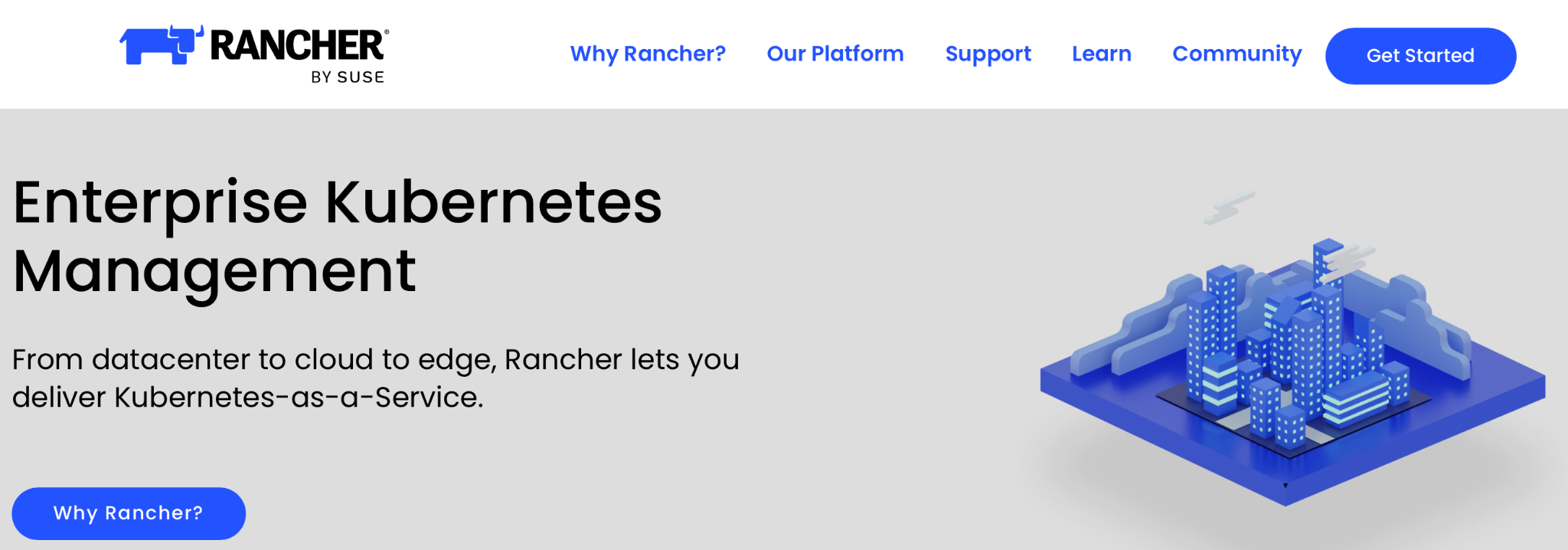
Rancher is SUSE's open-source Kubernetes management platform that centralizes cluster provisioning, monitoring, and policy enforcement in a single dashboard. It supports any CNCF-certified distribution, including RKE2, K3s, EKS, AKS, and GKE, and available as a free community edition or Rancher Prime with enterprise support.
Key Features
- Multi-cluster management: one dashboard for clouds, data centers, and edge
- Centralized policy enforcement: global RBAC and security across all clusters
- Distribution-agnostic: import any CNCF-certified cluster with no lock-in
- Built-in Helm catalogue: deploy applications across clusters from one place
Strengths
- Best multi-cluster management across hybrid and multi-cloud environments
- Works with any Kubernetes distro without proprietary lock-in
- Free community edition available; Rancher Prime for enterprise teams
Weaknesses
- Complex setup: architecture decisions require solid Kubernetes knowledge upfront
- Not beginner-friendly: assumes prior Kubernetes experience throughout
- Customer support quality varies across enterprise users
- Adds management overhead: Rancher itself requires infrastructure to run
Pricing
Community edition is free and open source. Rancher Prime moved to CPU/vCPU-based annual subscription pricing in 2025. SUSE provides exact costs based on workload size.
G2 Rating: 4.4/5.0
Why Choose Rancher: Best for platform engineering teams managing multiple Kubernetes clusters across hybrid or multi-cloud environments who need centralized visibility and control without vendor or distribution lock-in.
7. Mirantis Kubernetes Engine
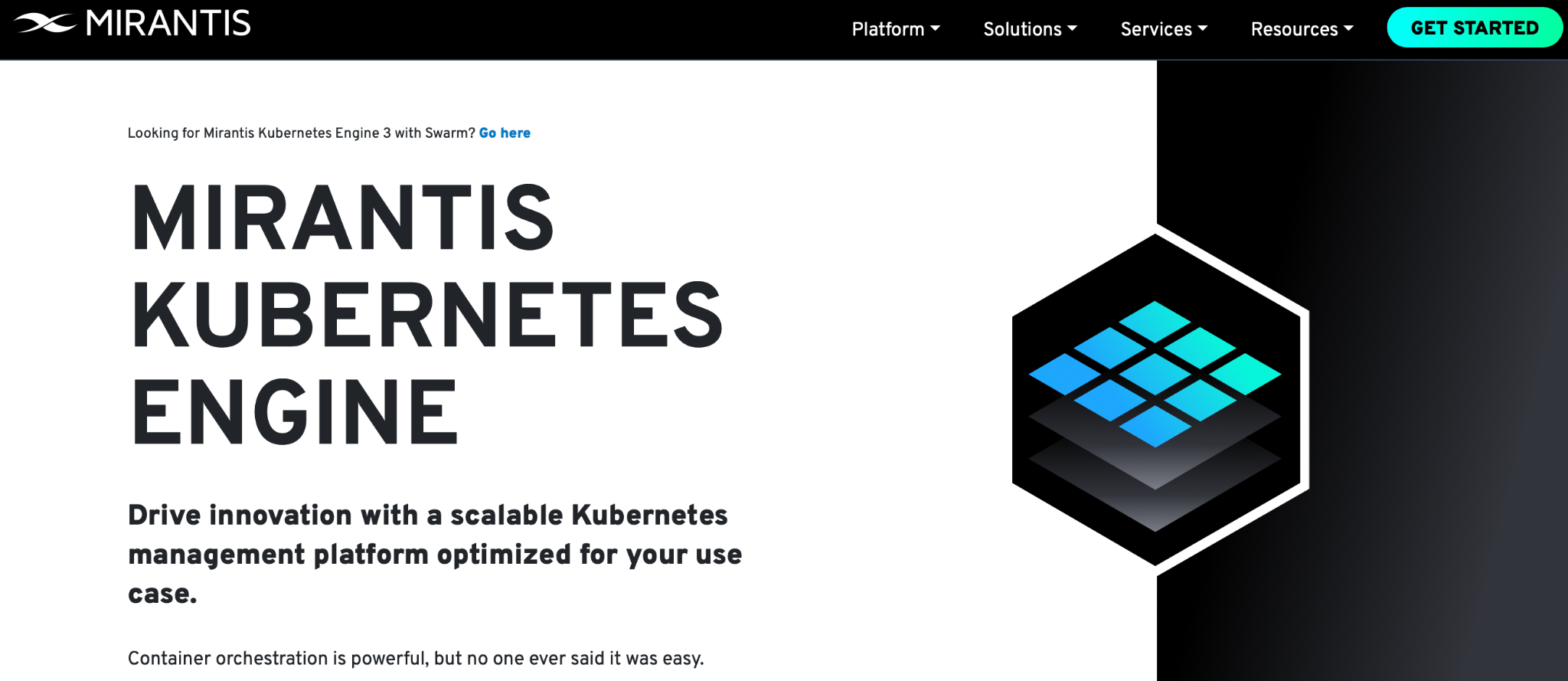
Mirantis Kubernetes Engine started as Docker Enterprise before Mirantis acquired it in 2019. MKE 4 rebuilt the platform on a fully open-source composable architecture based on k0s. It delivers both Kubernetes and Docker Swarm orchestration on a single platform, targeting enterprises and government organizations that need CNCF-certified, cloud-neutral Kubernetes with DISA STIG and FIPS 140-2 compliance.
Key Features
- Composable open-source architecture: swap validated CNCF components for networking, ingress, and storage without proprietary lock-in
- Converged infrastructure: containers and VMs run side by side via KubeVirt on one platform
- Declarative lifecycle management: automated drift correction keeps clusters in their desired state
- Runs anywhere: bare metal, private cloud, or public cloud across Linux distributions
Strengths
- Cloud-neutral and infrastructure-agnostic: no lock-in to any cloud provider or distribution
- Strong security posture: DISA STIG, FIPS 140-2, and granular RBAC for regulated industries
- Responsive enterprise support: consistently praised for fast resolution and knowledgeable teams
Weaknesses
- Expensive licensing: subscription costs are high despite most features existing in the free edition
- Steep learning curve: significant complexity during initial setup and configuration
- No pay-as-you-go flexibility: license model makes cost scaling difficult
- Documentation gaps: users flag incomplete and outdated docs across review platforms
Pricing
Subscription-based pricing billed annually per node with Basic 8x5 and Enterprise 24x7 support tiers. Mirantis Container Runtime starts at $1,125 per node per year. MKE pricing requires a direct Mirantis quote.
G2 Rating: 4.4/5.0
Why Choose MKE: Best for enterprises and government organizations running Kubernetes on bare metal or private cloud infrastructure that need cloud-neutral operations, strong security controls, and commercial support without hyperscaler dependency.
8. Nutanix Kubernetes Platform
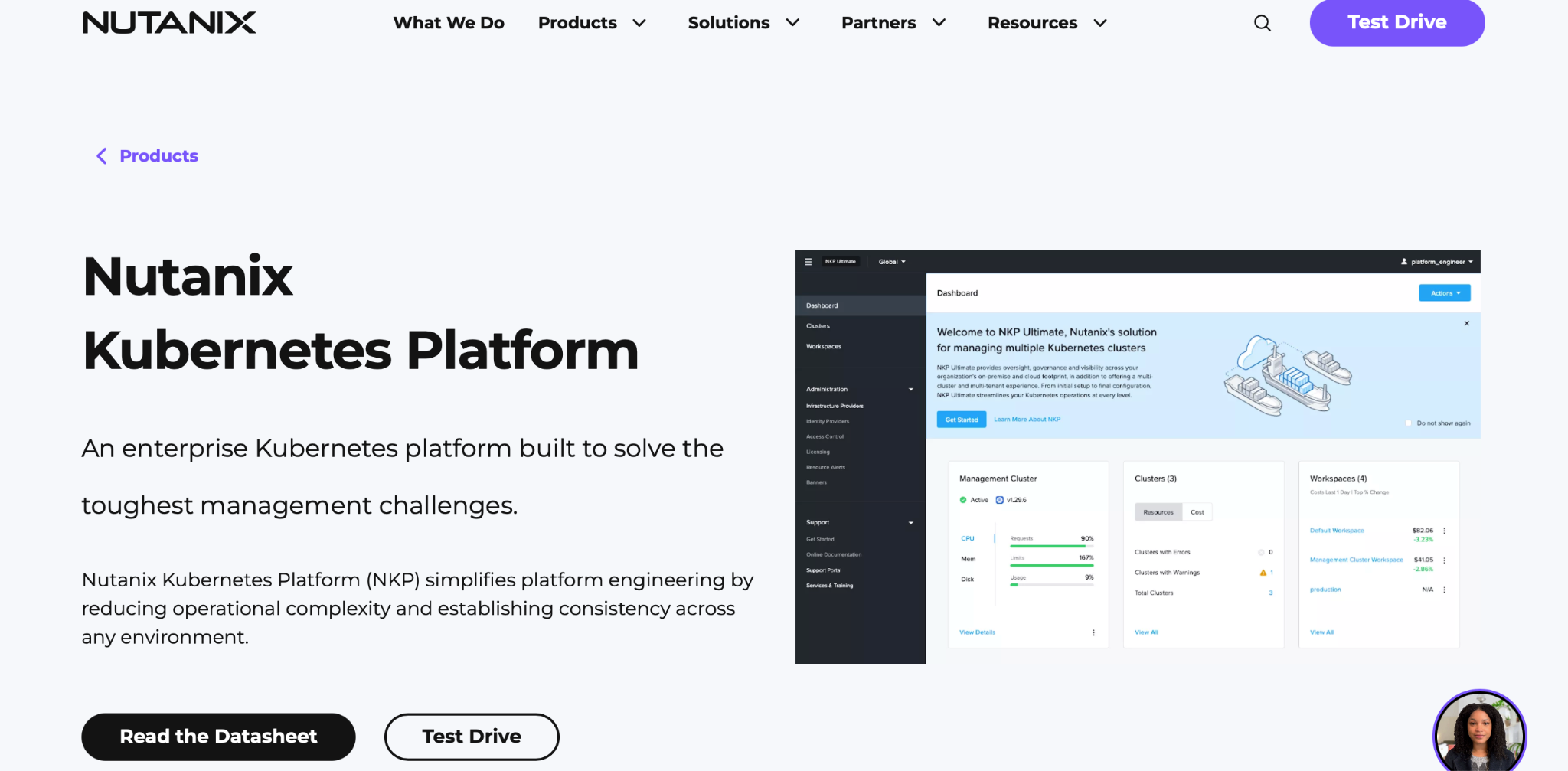
Nutanix Kubernetes Platform automates Kubernetes deployment, security, upgrades, and governance across on-premises, hybrid cloud, edge, and air-gapped environments. Built on pure upstream Kubernetes without proprietary API wrappers, NKP serves large enterprises and government organizations.
Key Features
- Fleet management: one console across on-premises, cloud, edge, and air-gapped environments
- AI insights: anomaly detection and root-cause analysis across clusters automatically
- NKP Metal (early access): bare-metal containers and VM support for AI and edge workloads
- NSA/CISA compliance: vulnerability scanning and automated enforcement built in
Strengths
- Pure upstream Kubernetes: no proprietary APIs, no distribution lock-in
- Broad infrastructure coverage: manages Nutanix, VMware, bare metal, and public cloud
- AI observability included: no third-party monitoring stack required
Weaknesses
- Complex setup: significant Kubernetes expertise required before production
- Expensive at scale: CPU core-based licensing grows fast for larger teams
- Confusing pricing: difficult to calculate total cost before committing
- Support gaps: slow response times reported by verified users
Pricing
NKP Full Stack is priced per CPU core on bare metal and per vCPU on virtual machines and cloud environments. NKP Starter is bundled with NCI Pro and Ultimate. Pricing requires direct contact with Nutanix.
G2 Rating: 3.8/5.0
Why Choose NKP: Best for large enterprises and government organizations managing distributed Kubernetes across hybrid, edge, and air-gapped environments that need strong security compliance, centralized fleet management, and reliable scalability.
9. IBM Cloud Kubernetes
IBM Cloud Kubernetes Service manages the control plane, etcd, and the cluster lifecycle, and provides automatic multi-zone high availability. It runs both community Kubernetes and Red Hat OpenShift on the same IBM Cloud platform, giving enterprises deployment flexibility without switching providers.
Key Features
- Free control plane: teams pay only for worker nodes
- Native IBM integrations: logging, monitoring, registry, and key management
- Security compliance: benchmarks, image scanning, and pod security included
- Multi-zone HA by default
Strengths
- Free control plane: no cluster management fees on top of worker node costs
- Enterprise security and compliance tooling built in
- Full API, CLI, and Terraform support
Weaknesses
- Fewer integrations outside IBM Cloud
- Limited global regions
- Steep IBM Cloud learning curve
- Small developer community
Pricing
Control plane is free. Worker nodes are billed at VPC rates. Block storage, load balancers, and egress are charged separately. A free 30-day single-node cluster is available for testing.
G2 Rating: 4.3/5.0
Why Choose IBM Cloud Kubernetes: Best for large enterprises already in the IBM Cloud ecosystem that need production-ready Kubernetes with a free control plane, built-in security, and deep integration with IBM enterprise services.
10. Linode Kubernetes Engine (LKE)
Linode Kubernetes Engine combines Linode’s developer-friendly compute infrastructure with Akamai’s global edge network, delivering managed Kubernetes across two tiers: LKE for smaller deployments and LKE Enterprise for large-scale production workloads requiring dedicated resources and advanced security.
Key Features
- Free standard control plane: teams pay only for worker nodes, storage, and load balancers
- CNCF-certified conformance: portability standards with access to latest Kubernetes updates
- LKE Enterprise tier: dedicated control plane, Cilium CNI, VPC isolation, up to 5,000 pods
- Akamai edge integration: CDN, DDoS protection, and serverless compute alongside clusters
Strengths
- Free standard control plane: no baseline cluster management fee
- Highly regarded documentation: consistently praised across the cloud developer community for clarity and depth
- Transparent flat-rate pricing: predictable billing with no surprise egress charges
Weaknesses
- Smaller ecosystem: fewer native integrations vs AWS, GKE, and Azure
- Limited regional footprint: fewer data centers for globally distributed deployments
- LKE Enterprise is paid: HA with advanced security and VPC isolation costs $300/month per cluster
- Limited advanced features: complex infrastructure teams may outgrow it
Pricing
Standard control plane is free. High-availability control plane costs $60 per cluster monthly. LKE Enterprise costs $300 per cluster monthly. Worker nodes start at $5 per month.
G2 Rating: 4.5/5.0
Why Choose LKE: Best for developers, startups, and mid-market teams that need affordable managed Kubernetes with transparent pricing and without the advanced integrations or global footprint of hyperscalers.
Comparing the best 10 managed Kubernetes service providers
The table below compares top managed Kubernetes service providers to help you make the right choice.
Final thoughts
Choosing the right managed Kubernetes provider comes down to cost, complexity, and control. Team size, infrastructure strategy, and budget ultimately determine the right fit.
GKE, EKS, and AKS work best for teams locked into a specific cloud. Rancher labs and Mirantis serve hybrid and on-prem environments. Each provider in this list has its place.
For teams that need production-ready Kubernetes without cost overhead or vendor lock-in, Rackspace Spot is the strongest choice. Auction-based pricing, a free control plane, and no lock-in: no other provider on this list combines all three.
Ready to get started? Visit spot.rackspace.com to deploy your first cluster.
Frequently Asked Questions
What is a managed Kubernetes service?
A third party handles the control plane, upgrades, and security. Teams focus on deploying applications while the provider manages the infrastructure.
Which managed Kubernetes provider is best for startups?
Startups need transparent pricing, low setup complexity, and no long-term commitments. Rackspace Spot and Linode Kubernetes Engine are strong options for cost-conscious teams.
How much does managed Kubernetes cost?
EKS and GKE both start at $73 per month per cluster before any node costs. GKE charges $0.10 per hour per cluster. A comparable Rackspace Spot cluster starts around $13 per month at current market rates: over 90% cheaper than hyperscaler pricing.
Can I switch Kubernetes providers without downtime?
Possible, but requires workload migration, storage reconfiguration, and networking updates. Open-source tooling and GitOps support make migrations cleaner. Rackspace Spot's Terraform and CLI are built for portability.
What should I look for in a managed Kubernetes provider?
Prioritize cost transparency, low setup complexity, no vendor lock-in, and a free control plane. Rackspace Spot delivers all four with no long-term contracts required.
When does managed Kubernetes not make sense?
Managed Kubernetes adds overhead that small teams running a handful of containers rarely need. If your workload runs comfortably on a single server or a basic PaaS platform, the complexity of Kubernetes is hard to justify regardless of who manages it.